Wi-Fi jammer
Cut a neighbour's Wi-Fi from 87.7 to 0.02 Mbit/s
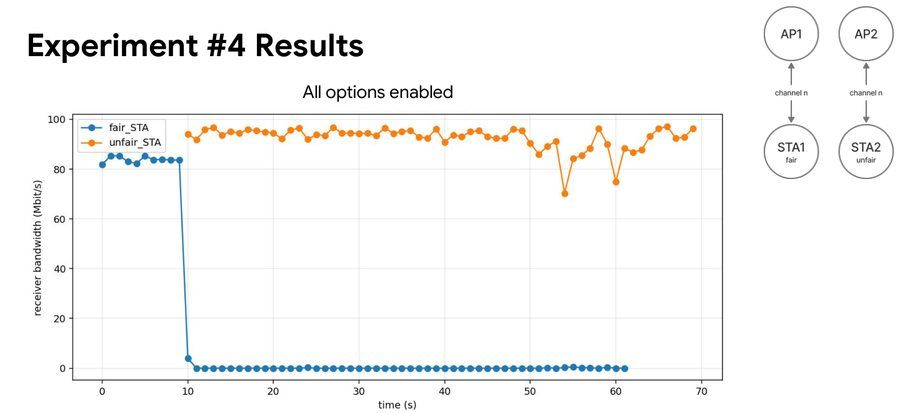
- 0.02Mbit/s left for the well-behaved station, down from 87.7
- 96.0Mbit/s taken by the modified station
- 4.16Mbit/s for the fair link, even after it changed channel
What we showed
One Wi-Fi station with a modified Linux driver (ath9k) can ignore 802.11’s rules for sharing the channel and take almost all of it from a well-behaved neighbour.
The setup
Automated, scripted experiments on NITLab, the university’s wireless testbed. A fair station and a modified one each tried to send 150 Mbit/s of UDP traffic with iperf for 60 seconds, first alone, then together.
What we measured
Average throughput on one access point.
| Case | Fair station | Modified station |
|---|---|---|
| Each alone | 87.7 Mbit/s | 96.5 Mbit/s |
| Both unmodified, sharing | 38.5 Mbit/s | 48.2 Mbit/s |
| One modified, same access point | 0.02 Mbit/s | 96.0 Mbit/s |
| One modified, separate access points | 0.12 Mbit/s | 92.9 Mbit/s |
| The fair link changes channel | 4.16 Mbit/s | followed it |
With normal drivers the two stations split the channel roughly evenly. With one modified, the fair station was left with almost nothing, on the same access point or on separate ones, and even after it moved to another channel.
What it means for defenders
Wi-Fi fairness depends on every device following the rules. One misbehaving device on ordinary hardware can take over a network, and changing channel does not escape it.
Team


Tools
What this project was built with. Pick one to see where else I used it.